
Read our previous article: “Understanding The Nuances of The U.S. Plastics Prices, Supply Chain, and Production” to fully understand key background information and data backing it.
Here is a Quick Summary of the Key Conclusions Established in the Previous Article:
- Plastics prices are rising.
- The war in Iran is shutting off global supply of key inputs to create plastics and polyethylene products.
- The U.S. does not rely on inputs from the middle east to produce domestic plastic resins.
- The U.S. relies on a large domestic natural gas supply to refine into feedstocks and create plastics.
- Plastic prices are rising, and input prices to create plastics are not, leaving questions about why prices are increasing.
Natural Gas is the Key Input for U.S. Plastic. Why are Plastic Prices Rising When Natural Gas Isn’t?
The U.S. natural gas supply is immense, the ability to export or use it is not great enough to cause any supply constraints that would cause prices to go up. Unlike the rest of the world, the U.S. essentially has too much natural gas. This is evident by the difference in how much natural gas costs in the U.S ($3.25USD/MMBtu) compared to the European price benchmark ($14.13USD/MMBtu). Prices sourced from tradingeconomics.com on 6/22/2026
Natural gas prices cannot rise or normalize to overseas prices because current infrastructure does not have the capacity to export enough natural gas to converge the supply and demand dynamics of the U.S. and overseas.
Because the U.S. cannot sell (or rather sell enough to have an effect) to the higher bidder overseas, prices are unable to rise to the overseas prices.
However, this is different for the U.S. plastics market. Exporting and shipping plastic overseas is much less complex than natural gas, allowing the domestic price to normalize closer to global prices more than natural gas is able to.
This is evident by the fact that plastic resin producers have consistently raised prices throughout the Iran conflict while natural gas producers have not increased prices significantly.
PlasticsToday reports:
“Dow Chemical Chief Operating Officer Karen Carter noted that polyethylene pricing rose $0.05 per pound in January and ticked up another $0.10 in March. A $0.30 increase is proposed for April with another $0.20 on the table for May. Around half of global ethylene and polyethylene supply is offline, constrained, or directly impacted by the conflict, added CEO Jim Fitterling.”
For the U.S. plastic market, natural gas is the key input to producing resins. Natural gas prices have not risen significantly like plastic prices. So we can conclude that the domestic price increase in plastics is driven by competition with higher willingness to pay buyers overseas and not feedstock prices. This applies to the U.S. market only as we have a large unaffected supply of feedstock that can be used in plastic production that other countries do not have.
For this reason, plastic prices have risen closer to global benchmarks despite the fact that domestic inputs to produce the plastic have stayed around pre Iran war levels.
Recently, data on plastic products exports out of the U.S. has been released for the month of April 2026 by the U.S. Census Bureau. Shown below is the graph of total value of plastics.
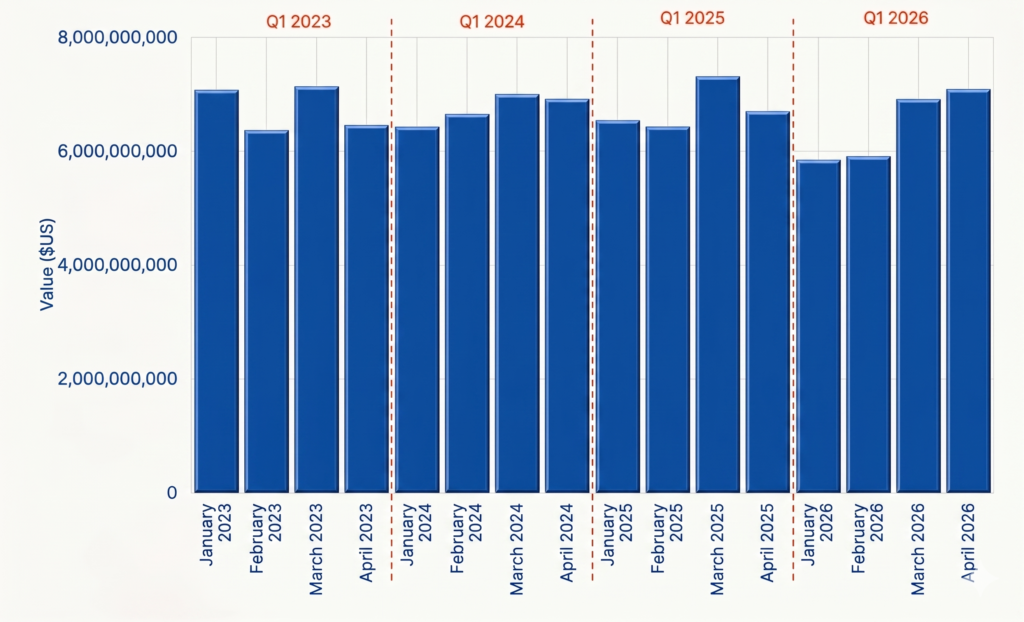
There is a slight increase in export value following the beginning of the Iran war, however, the total value of exports in March or April is not out of the ordinary from the same months in previous years.
For reference the Strait of Hormuz closed March 4th. It is logical to see a noticeable increase in export value in the following months.
Despite “around half of global ethylene and polyethylene supply” being “offline” and large price increases for resin across the board of suppliers, the total value of plastic exports is not at significant levels.
However, for domestic buyers of resin, prices seem to be at significant levels.
Many plastic market news outlets and plastic industry companies attribute the rising cost to the war in Iran and increased competition for the commodity with overseas buyers. However, data from the U.S. Census Bureau does not indicate exportation on the level that we would expect given the rate at which domestic plastic prices are rising.
An Economic Theory “Export Parity” Could Provide Some Insight Into Understanding This Un-intuitive Relationship.
Export parity is the net price a producer receives when exporting a good rather than selling it locally. It is calculated by taking the global market price and subtracting the cost of freight, logistics, and tariffs.
This concept explains the mismatch between flat export data and rising domestic prices through two simple economic realities:
1). Pricing is Driven by Opportunity Cost, Not Physical Volume
Even if producers keep 100% of their product in the U.S. and don’t export a single extra pound, they know they could sell it overseas for a premium. Therefore, domestic prices naturally adjust upward to match this global benchmark, even while physical export volumes remain completely flat.
Producers can charge global prices to domestic buyers, and don’t need to incur large transportation and logistics costs to sell to global buyers and reduce margins.
2). The Structural Gap Between Domestic and Export Prices
A detailed Article by E. Esteban Sagel, a Chemical and Polymer Market Consultant, finds that U.S. domestic resin prices historically sit at a premium above export clearing prices. Suppliers frequently use the international export market as a “volume valve,” selling excess resin at a discount to keep their plants running at high efficiency.
When a global supply shock occurs, the baseline price of those discounted export channels rises. Because distributors’ domestic resin procurement contract prices are normally tied to these global realities, the entire U.S. pricing tier shifts upward to maintain the producer’s integrated value chain earnings.
Ultimately, the data from the U.S. Census Bureau does not represent a logical contradiction. It simply demonstrates that U.S. resin is fully integrated into the global economy. While the U.S. abundance of natural gas keeps local production costs low and stable, the value of the finished plastic resin is tied to global demand.
Disclaimer
This report is provided for informational purposes only and does not constitute business, financial, or purchasing advice. Creek Plastics assumes absolute zero liability for any direct, indirect, or consequential losses, damages, business decisions, or legal claims resulting from the use of or reliance on this material.
The market data, statistics, and industry insights presented herein are compiled and aggregated from external, third-party public sources. Creek Plastics claims no ownership, proprietary rights, or original authorship over this third-party information; all credit, intellectual property, and copyrights belong entirely to their respective original sources and authors. While this information is gathered from sources believed to be reliable, Creek Plastics makes no guarantees regarding its accuracy, completeness, or timeliness.
Furthermore, any quotes, statements, or commentary attributed to specific individuals, public figures, or corporate executives (including those from external companies) are derived from public records, earnings calls, or media reports and are provided “as-is.” Creek Plastics does not warrant the literal accuracy, completeness, or context of these third-party statements and explicitly disclaims any liability for inadvertent misquotes, transcription errors, or mischaracterizations.