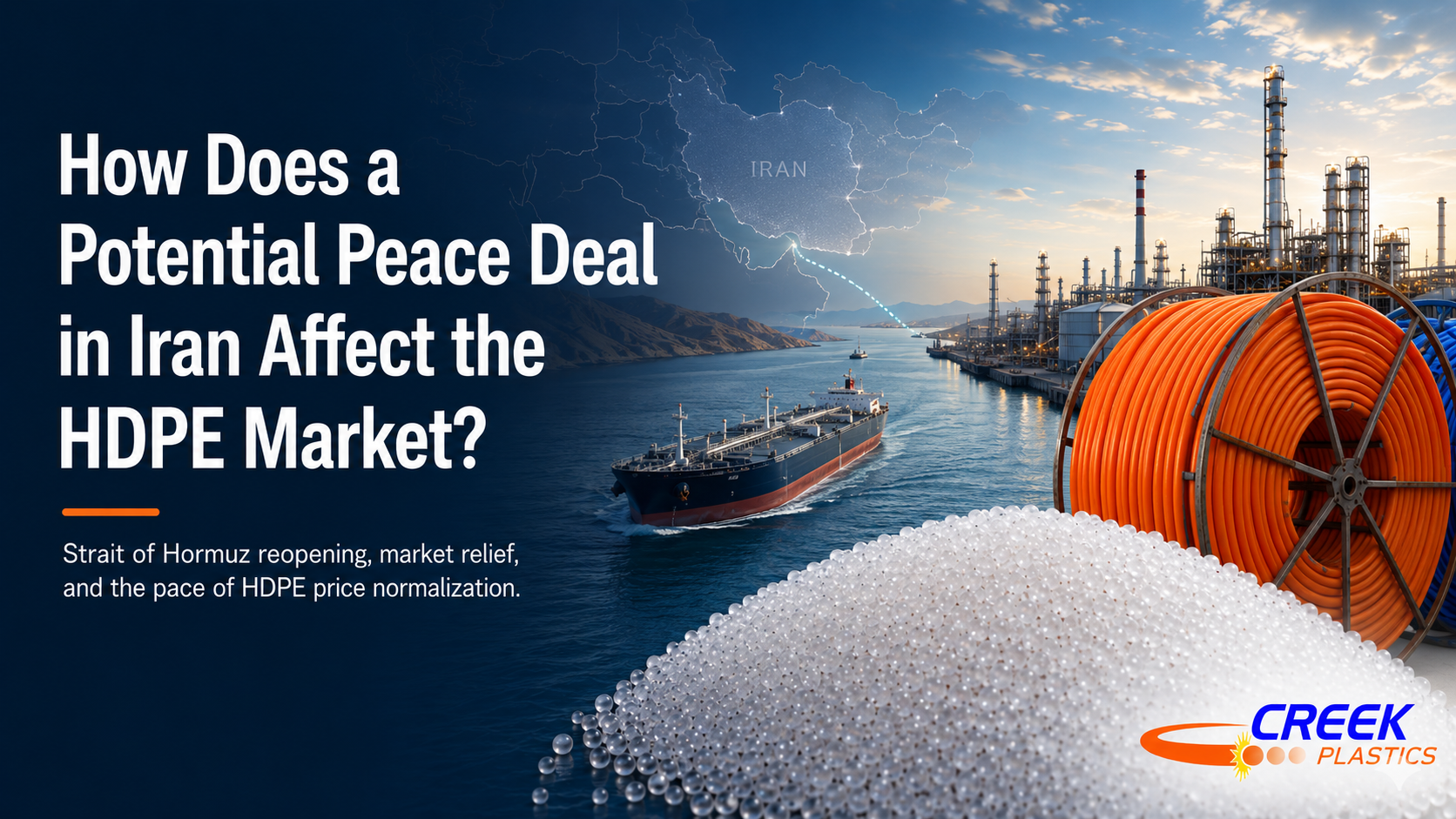
How Does a Potential Peace Deal in Iran Affect the HDPE Market?
HDPE resin is heavily tied to the conflict in the Middle East through supply disruptions and market dynamics.
The Strait of Hormuz accounts for roughly 33% of global polyethylene exports. The core relationship is this: As the commodity gets more scarce, prices rise.
On June 14th, 2026, Iran and the U.S. entered into a ceasefire deal that set up a peaceful 60-day deal-making period to discuss the many technicalities of a long-term agreement.
Upon the announcement of this, oil futures and prices at the local gas pump have gone down. These are key indicators that the market is pricing in less risk of prolonged supply shortage.
Oil futures for Brent and West Texas are down ~10% from announcement of this ceasefire, and down ~30% from June 2026 highs.
But What Does This Mean for HDPE Pricing?
HDPE is a commodity heavily tied to the Iran conflict just like oil is. HDPE and other plastics are down ~10% in the last 30 days driven by improvements in Iran.
However, this decrease is the result of the market simply cutting prices because of decreased risk not because of actual supply entering the market. With this deal, buyers and sellers are more optimistic about the future prices and are willing to agree on buying and selling at a lower price now instead of waiting.
Many Iran conflict experts agree that markets will not fully recover until months after peace and trade flows in the Strait.
Factors Contributing to a Slow Normalization of Iran Conflict Affected Markets
- During the closure of the Strait, supply shortages stacked.
- Every day the Strait was closed the world missed out on the ~20 million barrels of oil export capacity, it will take time for inventories to catch up to normal levels.
- Port Congestion
- When the Strait opens, there will be a massive rush all at once for exports to begin flowing causing slowdowns due to capacity limits.
- War Risks
- Mine Clearing – the Strait requires expert mine clearing to ensure safety of tankers.
- Insurance War Premiums – Insurance on anything directly tied to the Strait, like tankers, is up significantly and will stay elevated longer.
- The ceasefire takes place for 60 days for officials to negotiate technical deal terms, leaving risks of no agreement, and re-escalation.
Effect on HDPE Pricing
For everything that comes out of the Strait, there will continue to be a risk premium attached to the price gradually decreasing over a longer period of time. Additionally, for the reasons above, pricing will likely, as a whole, decrease gradually over time.
Currently, the Strait has been reopened as a part of the ongoing ceasefire deal, but traffic is severely disrupted due to ongoing geopolitical tensions, changing security rules, and military standoffs. This is proof of concept for the idea of the slow normalization expectations.
Deal Terms of Ongoing Iran Ceasefire
To provide a holistic view of the market and the risks it’s important to understand the deal terms.
- All-Front Ceasefire: Immediate end to military operations between the U.S., Iran, and their respective allies, explicitly halting the conflict in Lebanon.
- Blockade & Maritime: U.S. lifts its naval blockade within 30 days; Iran reopens the Strait of Hormuz toll-free for a 60-day window.
- Oil & Commerce: U.S. immediately issues Treasury waivers for Iranian crude oil exports.
- Nuclear Freeze: Iran maintains its current nuclear status quo, halts higher enrichment, and agrees to negotiate the down-blending of its current stockpile.
- The $300B Fund: U.S. and regional partners establish a $300 billion economic reconstruction fund for Iran.
- 60-Day Clock: Both sides have 60 days to negotiate this temporary framework into a permanent, comprehensive treaty.
Concerning Variables in Iran Ceasefire Deal
Israel:
- Because Israel was completely excluded from the negotiations, Prime Minister Netanyahu has declared they are not bound by the deal. The IDF is actively defying the “Lebanon clause” with ongoing strikes and an indefinite occupation of southern Lebanon.
- Iran is already using the Lebanon clause as leverage, insisting that follow-up nuclear talks are dead on arrival unless the U.S. forces an Israeli military withdrawal.
Financial:
- The immediate issuance of U.S. Treasury oil waivers and the $300 billion regional fund offer a massive, front-loaded economic rescue package to Tehran before they have actually dismantled a single nuclear site.
- While the MOU technically halts active fighting from Iranian proxies, it lacks any verification mechanisms or restrictions to stop Iran from continuing to financially bankroll and re-arm Hezbollah or the Houthis during the 60-day window.
Key Takeaways
The HDPE and broader plastics market has already eased due to progression in the Middle East and technical “reopening” of the Strait. However, risks remain in the timeline for normalization and within the ongoing ceasefire possibly failing. As these risks continue to remain there will be a risk premium tacked onto the price of HDPE resin. This will ultimately result in a slower and more volatile decline in pricing across all affected commodities as the Iran conflict settles.
Disclaimer
This report is provided for informational purposes only and does not constitute business, financial, or purchasing advice. Creek Plastics assumes absolute zero liability for any direct, indirect, or consequential losses, damages, business decisions, or legal claims resulting from the use of or reliance on this material.
The market data, statistics, and industry insights presented herein are compiled and aggregated from external, third-party public sources. Creek Plastics claims no ownership, proprietary rights, or original authorship over this third-party information; all credit, intellectual property, and copyrights belong entirely to their respective original sources and authors. While this information is gathered from sources believed to be reliable, Creek Plastics makes no guarantees regarding its accuracy, completeness, or timeliness.
Furthermore, any quotes, statements, or commentary attributed to specific individuals, public figures, or corporate executives (including those from external companies) are derived from public records, earnings calls, or media reports and are provided “as-is.” Creek Plastics does not warrant the literal accuracy, completeness, or context of these third-party statements and explicitly disclaims any liability for inadvertent misquotes, transcription errors, or mischaracterizations.