Learn how to calculate the short-term and long-term bend radius for HDPE pipe and conduit. Includes job site visualizations, DR/SDR reference tables, formulas, and field safety rules.
The flexibility in polyethylene’s pipe makes the pipe easy to handle and install. All the major trenchless installations of polyethylene pipes rely on the pipe’s flexibility to avoid obstacles and handle curvature in the bore path. HDPE pipes can be bent to a tighter radius than PVC. HDPE pipe radius is about 1/10th the radius of PVC pipe. However, the type of HDPE pipe and the length of time bent add more nuances.
How to Measure Bend Radius
Pipe Sweeps less than 90 degrees
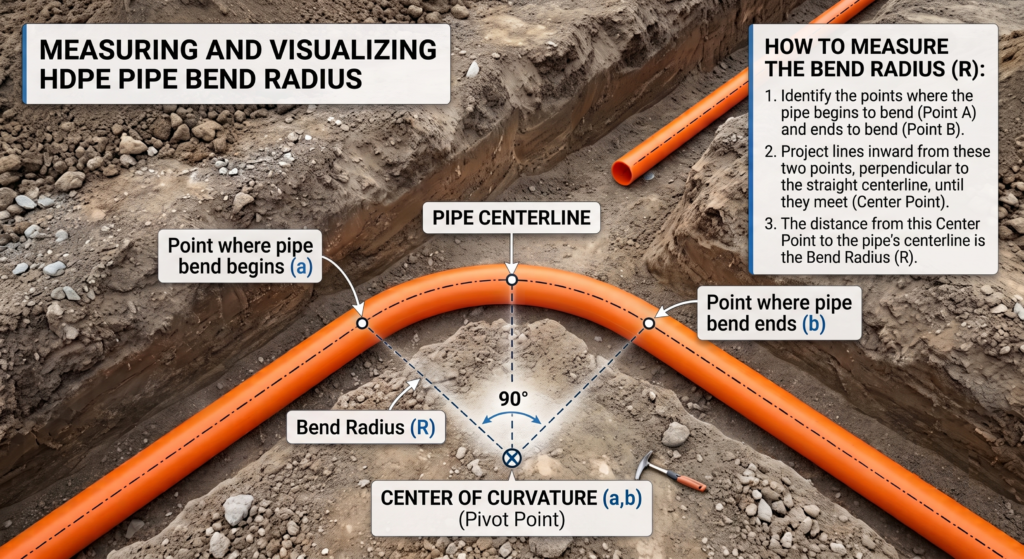
This diagram visualizes how to geometrically measure the bend radius (R) for a standard 90 degree HDPE pipe curve. It illustrates how to identify where the curve begins and ends (Points A and B) and project perpendicular lines inward to locate the center of curvature (Pivot Point). The distance from this pivot point to the centerline of the pipe defines the actual measured bend radius (R).
Pipe Bends Tighter Than 90 Degree Turns
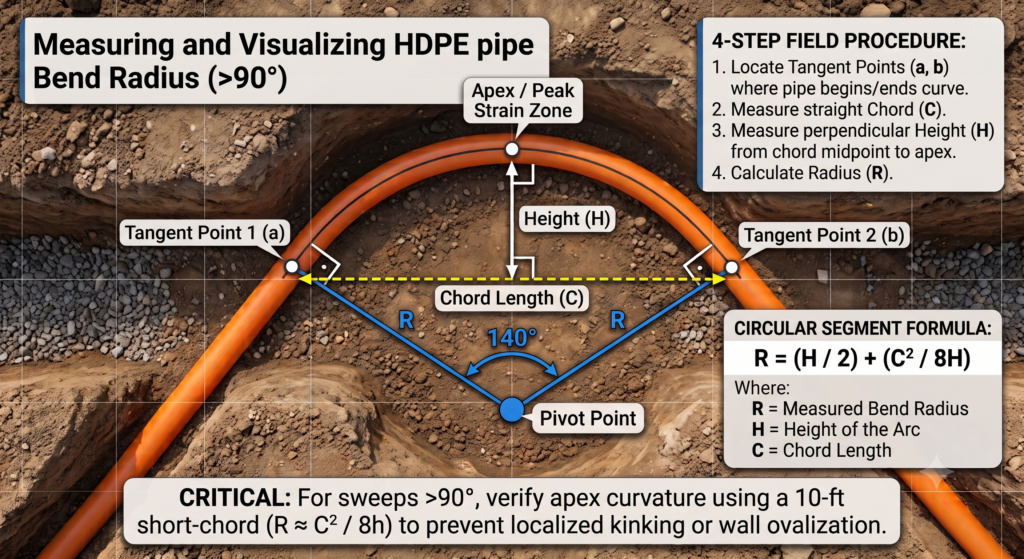
Why the Circular Segment Formula Can Be Misleading in the Field
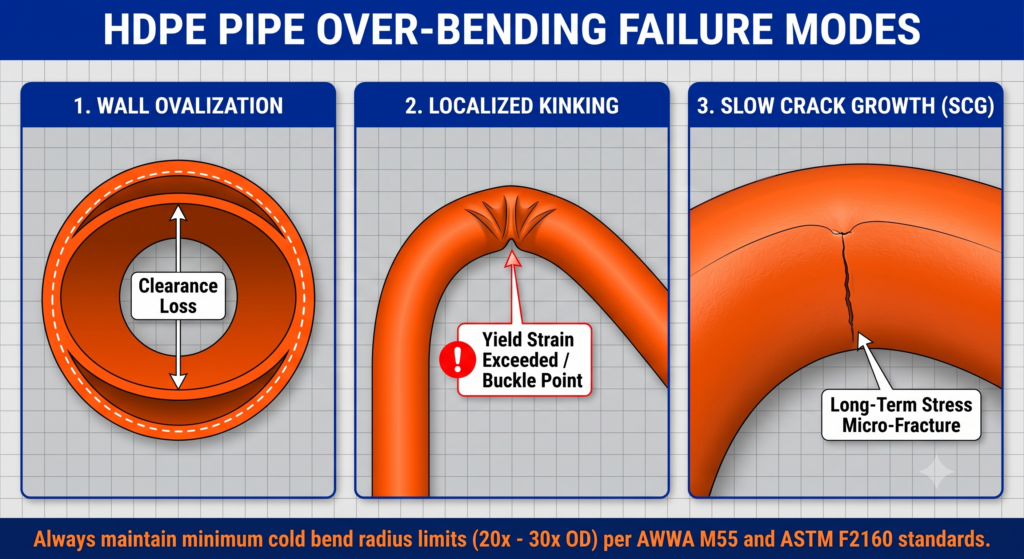
For sweeps greater than 90 degree turns the conduit will naturally bend most at the apex meaning measuring the whole bend start to finish and assuming equal bend throughout is misleading and will lead to over bending pipe causing ovalization, kinking, and slow crack growth, all of which potentially destroying the integrity of the line inside.
Because the circular segment formula is misleading, a 10-ft short-chord method is standard field practice.
When verifying a sweep in an open trench, finding the “center pivot point” in unexcavated dirt is often time consuming. The 10-Foot Short-Chord Method allows a technician to measure the actual curve radius much faster.
Step-by-Step Procedure
- Locate the Apex: Identify the tightest part of the curve (the middle/apex of the sweep), as flexible pipe naturally experiences its highest strain here.
- Set the 10-Foot String: Stretch a 10-foot string line (C = 120 inches) completely taut along the inside arc of the bent pipe at the apex.
- Measure the Offset (h): At the exact 5-foot midpoint of the string line, measure the perpendicular distance (h) in inches from the string straight to the inside wall of the pipe.
- Calculate the Radius (R): Plug your measured offset (h) into the simplified field formula:
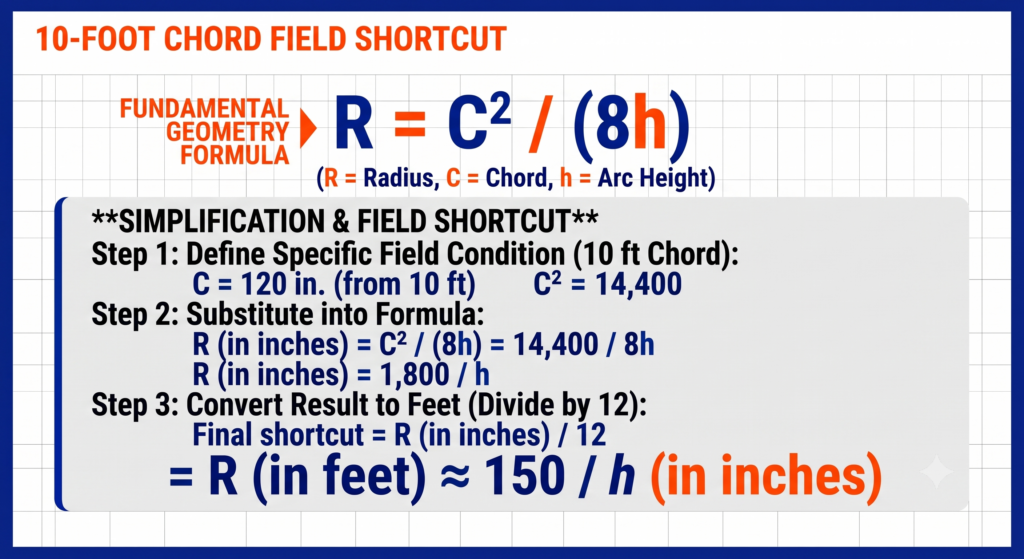
For tighter sweeps where the curve’s footprint or full-circle diameter is under 10 feet, a standard 10-foot string line will extend past the bend onto the straight pipe legs, distorting your measurement. In these scenarios, simply scale down your tape measure or string line to a shorter chord length, such as 3 or 5 feet, that fits entirely within the active arc between the curve’s entrance and exit tangent points. Holding this smaller pull chord taut against the inside arch allows you to measure the center offset (h) across the curve, ensuring an accurate localized radius calculation even in tight trench spaces or small-conduit runs.
How Tight Can The Bend Radius Be?
There are multiple variables that dictate how much you can bend a pipe safely including
- The temperature
- How long the pipe will be bent
- Type of pipe and wall thickness.
How does Temperature Affect HDPE Conduit Bend Radius?
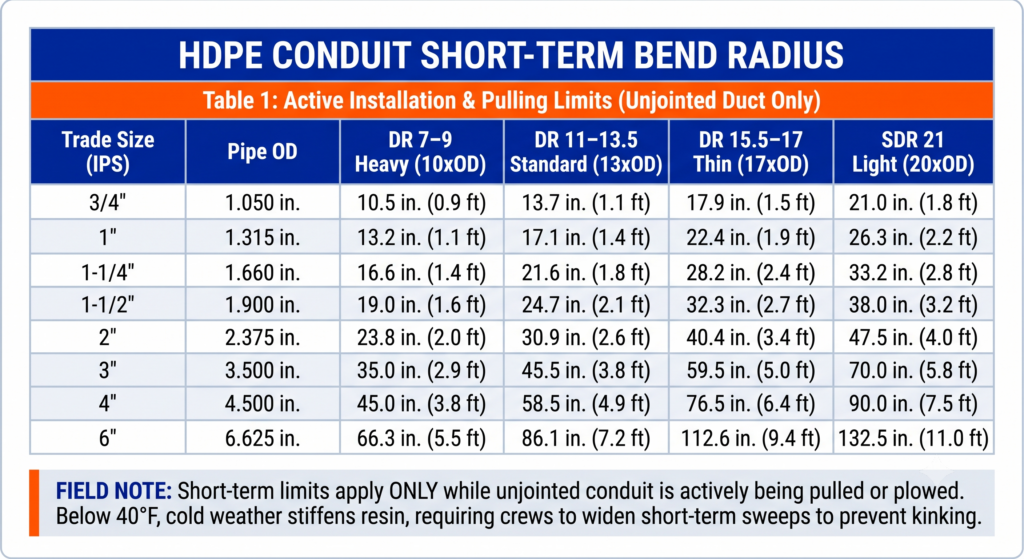
Temperature directly alters HDPE’s flexural modulus, changing how conduit behaves under bending stress. In cold weather, below 40 degrees fahrenheit, the resin stiffens significantly, increasing resistance to bending and raising the risk of wall kinking or impact cracking if forced into tight sweeps, requiring crews to widen bend radii or allow extra transition distance. Conversely, in hot weather, above 100 degrees fahrenheit, the material softens; while it flexes easily, it loses ring stiffness and becomes far more susceptible to cross-sectional ovalization or sidewall collapse when pulled around curves under tension.
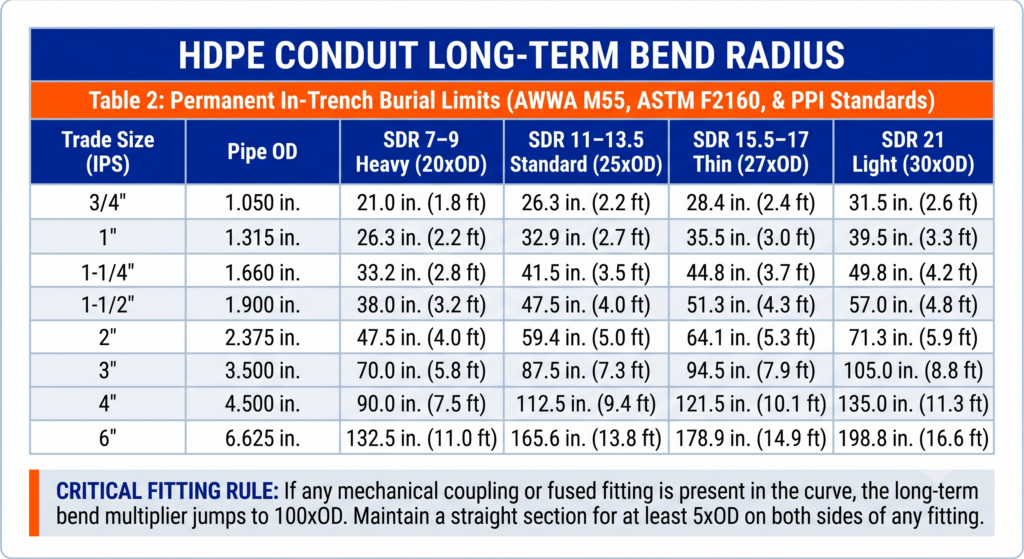
As a general rule, the permanent, in-trench bend radius must never be tighter than the pipe’s engineered long-term cold bend limit, but you are permitted to temporarily flex unjointed pipe down to a tighter short-term limit during active installation. This brings us to the next variable in the “how much can you bend HDPE conduit equation”