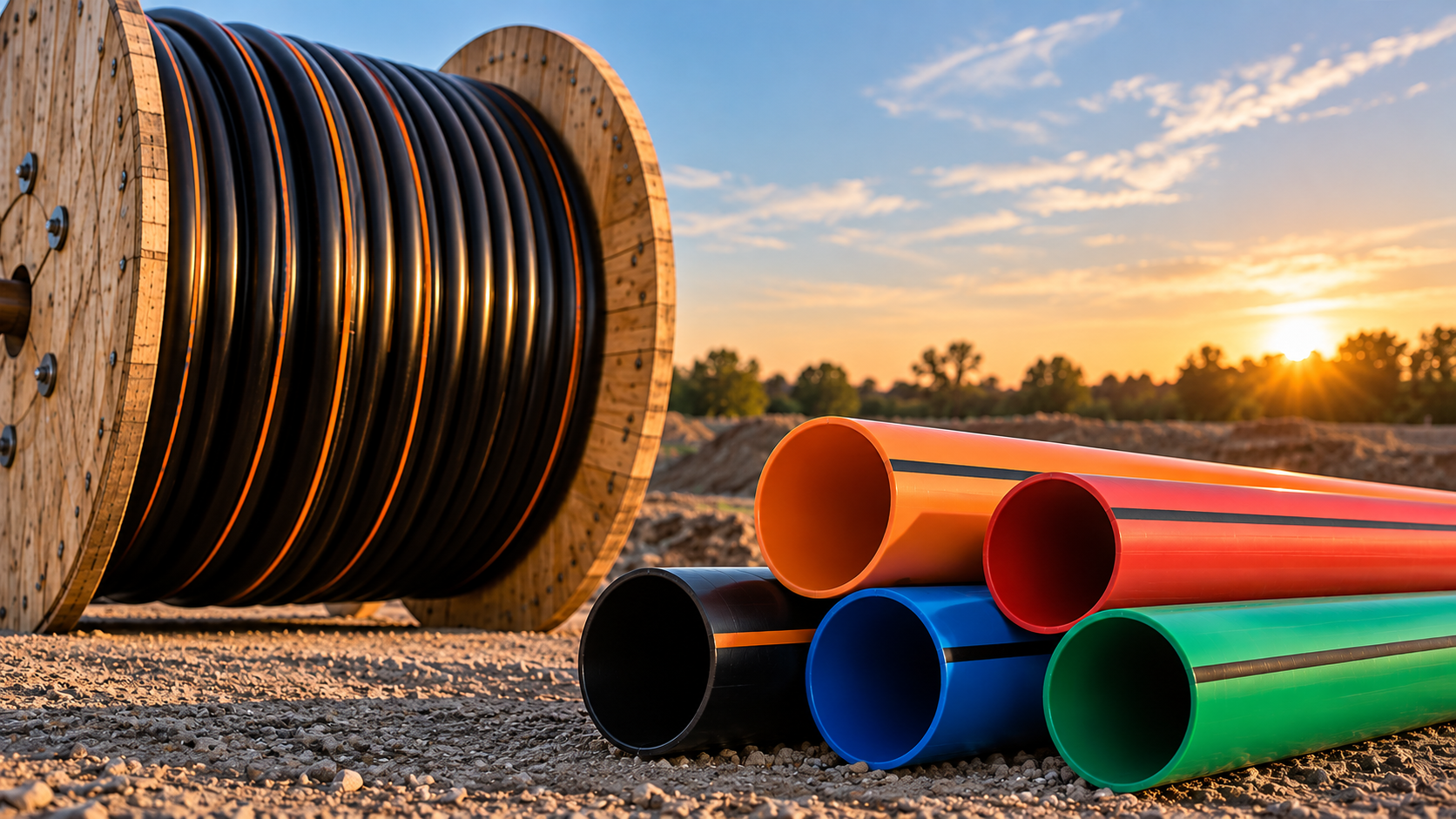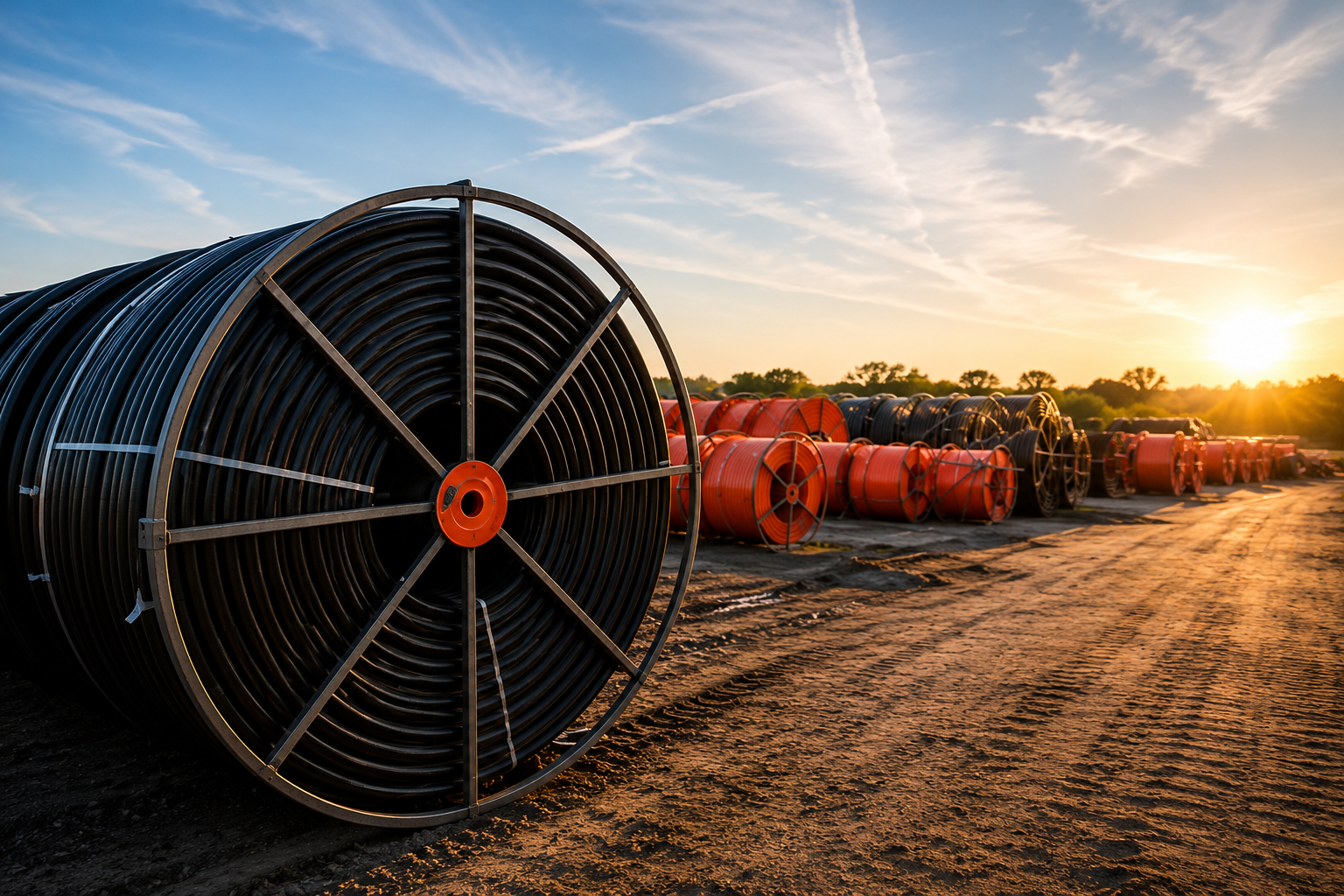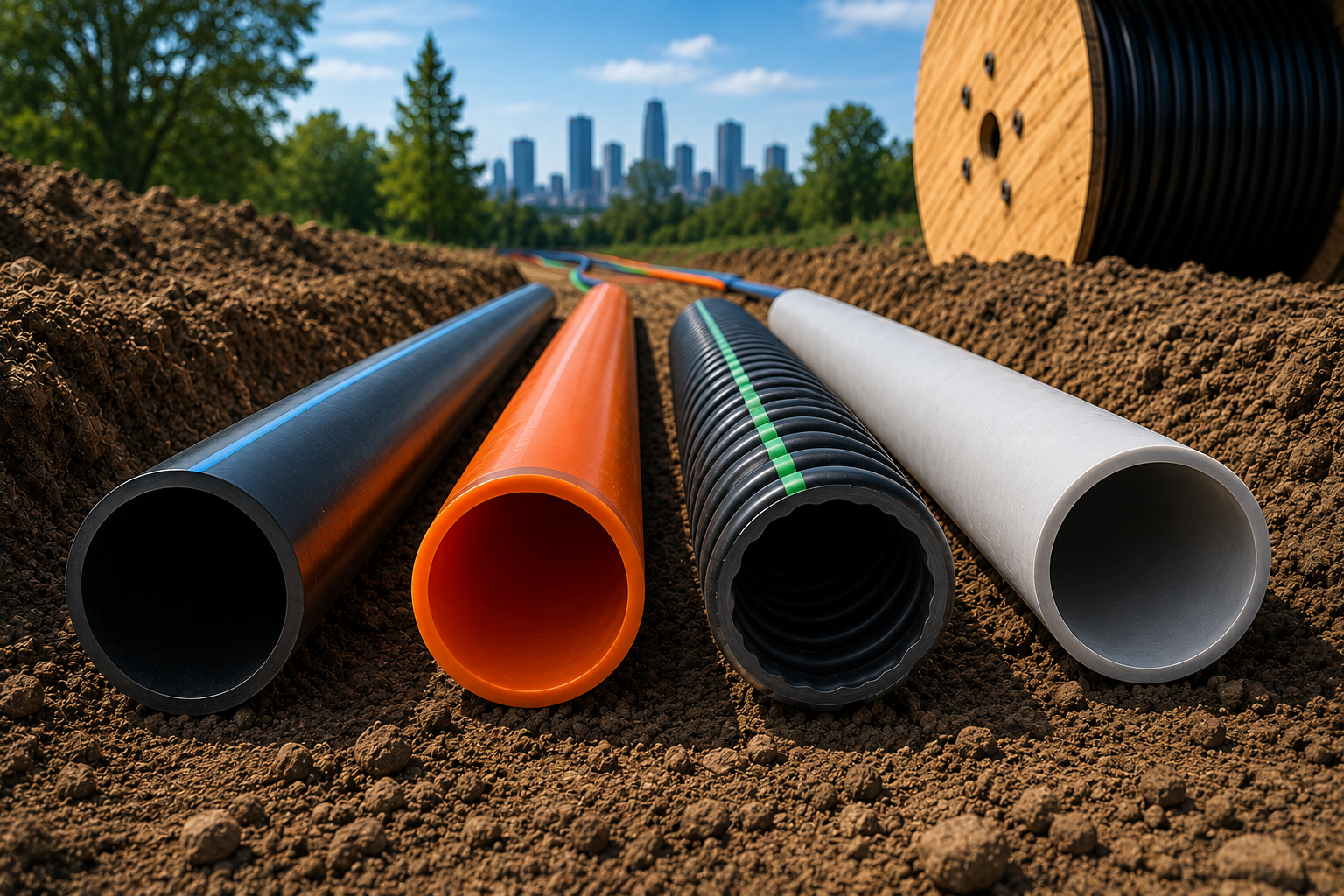
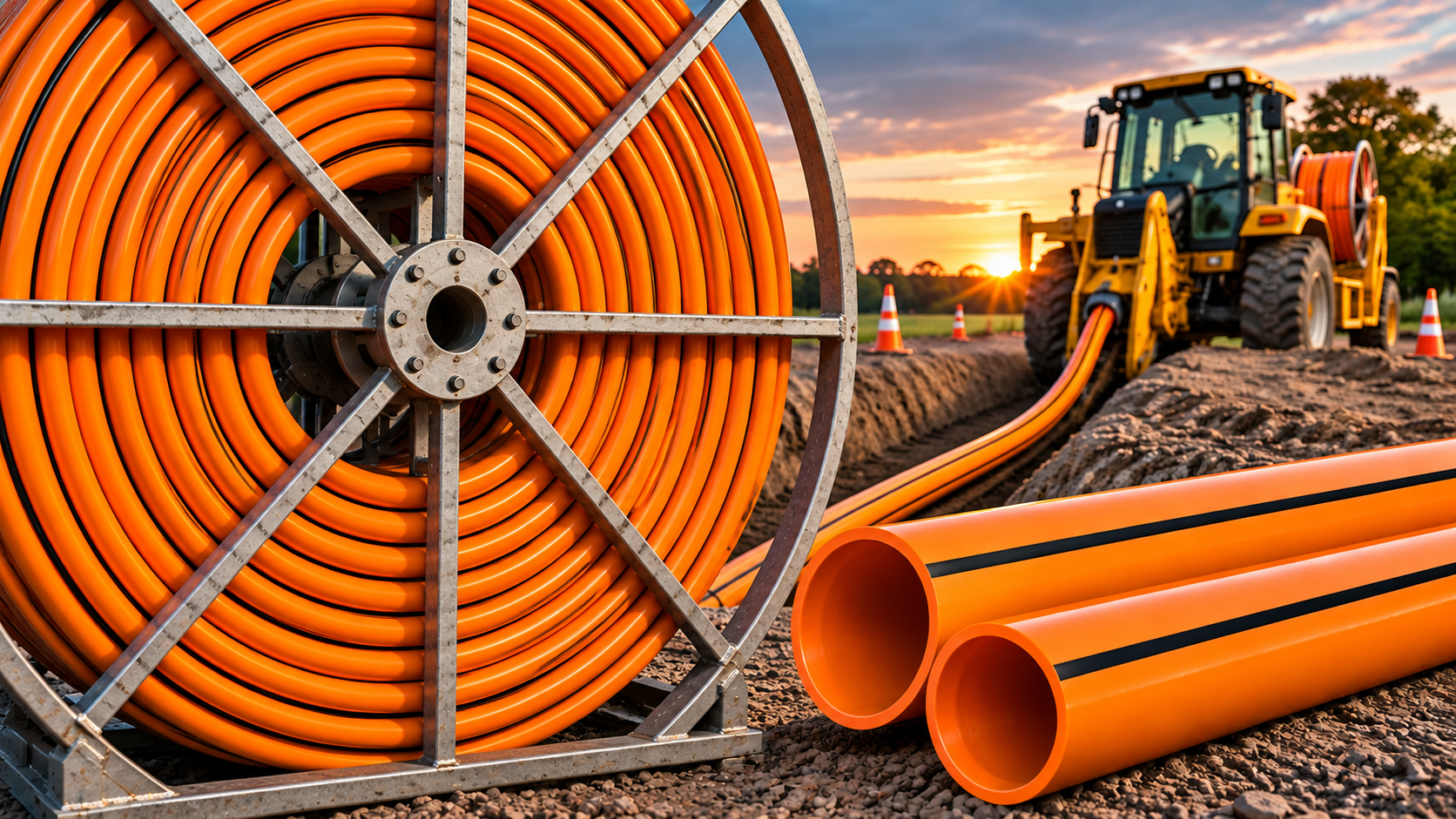
High-Density Polyethylene (HDPE) conduit provides the continuous, flexible pathways needed for modern telecommunications and fiber optic networks. Proper installation helps preserve the conduit’s structural integrity and internal clearance, supporting successful fiber optic cable pulling and air-assisted installation.
From open trenching and direct plowing to horizontal directional drilling (HDD), innerduct installation, and aerial placement, each method presents unique mechanical challenges.
This guide explores five common HDPE telecom conduit installation methods, the risks contractors encounter, and practical field considerations for protecting underground and aerial telecommunications infrastructure.
HDPE Telecom Conduit Installation Methods at a Glance
| Installation Method | Typical Application | Primary Concern |
|---|---|---|
| Open Trenching | New underground utility routes | Bedding and point loading |
| Direct Plowing | Long rural telecom routes | Bending and deformation |
| Horizontal Directional Drilling (HDD) | Road, river, and obstacle crossings | Pulling tension and borehole conditions |
| Innerduct Pulling | Existing underground conduit systems | Friction and internal clearance |
| Aerial Installation | Above-ground utility pole routes | UV exposure and thermal movement |
General Pre-Installation Guidelines for HDPE Conduit
Before beginning installation, contractors should account for two important material characteristics of HDPE conduit.
Coil Energy Management
Coiled HDPE conduit stores elastic energy. Cutting retaining straps or bands without properly restraining the material can cause the conduit to spring outward unexpectedly, creating a serious handling hazard.
Crews should follow manufacturer-recommended uncoiling procedures, use appropriate reel-handling equipment, and maintain control of the conduit throughout the payout process.
Temperature Sensitivity
HDPE’s stiffness and flexibility change with temperature.
- Cold Weather: HDPE becomes stiffer, which can increase the minimum bend radius needed for safe handling and installation. Crews should avoid abrupt bending and use additional care when uncoiling material in freezing conditions.
- Hot Weather: HDPE becomes more flexible and may be more susceptible to deformation or stretching under excessive pulling loads. Contractors should monitor pulling tension and avoid unnecessary mechanical stress.
Understanding these characteristics helps reduce installation damage and protect the conduit for future cable placement.
1. Open Trench and Continuous Trenching
Overview
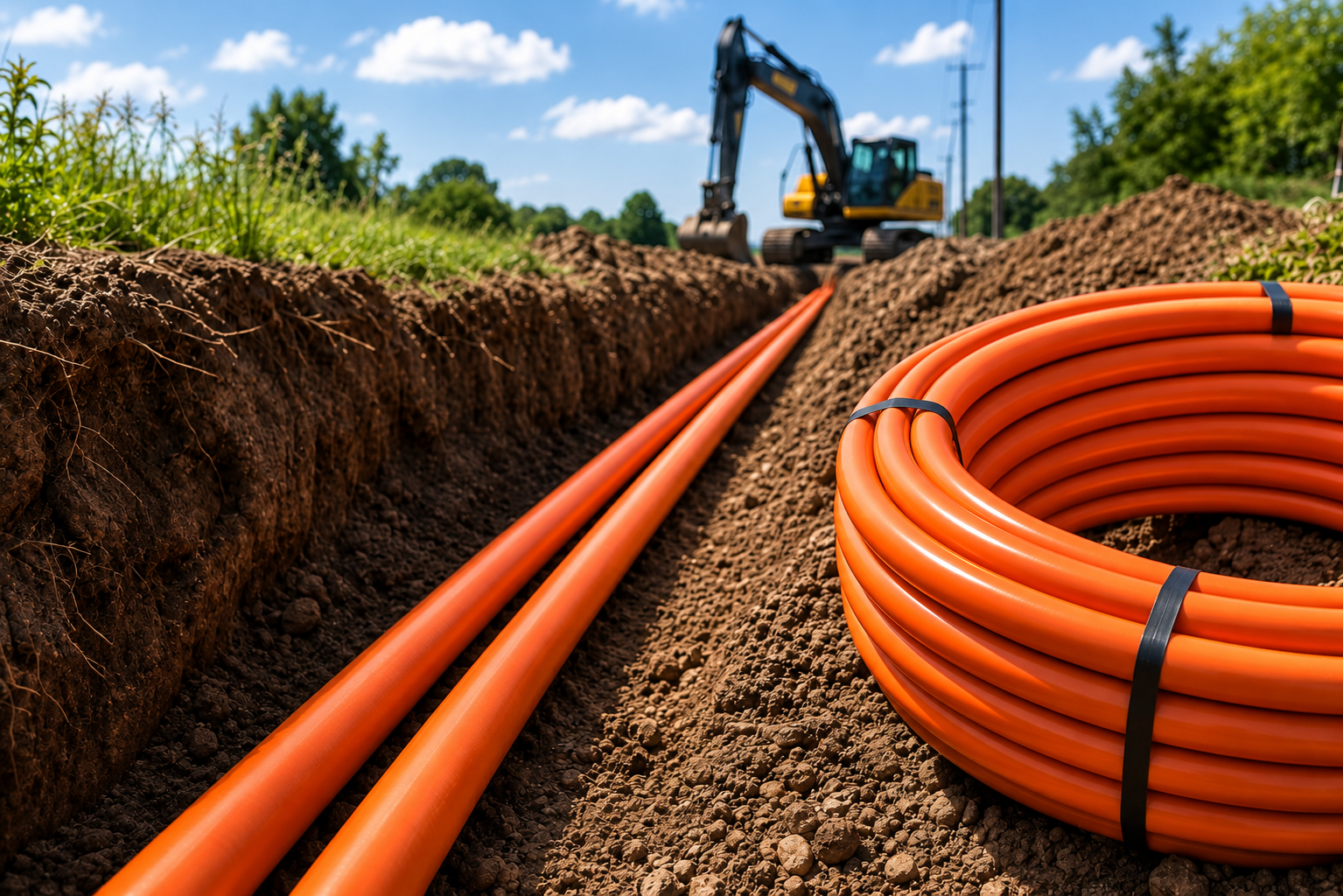
Open trenching involves excavating a trench, placing HDPE conduit along the prepared trench floor, and backfilling the excavation.
Continuous trenching uses specialized equipment that excavates a narrow trench while feeding conduit directly from a reel behind the trencher. This method is commonly used for long underground telecommunications and fiber optic routes.
Primary Risk: Point Loading and Improper Bedding
Sharp rocks, construction debris, and uneven trench surfaces can create concentrated pressure against the conduit wall.
Over time, these localized stresses may contribute to deformation or slow crack growth, potentially compromising the conduit and its internal clearance.
Field Strategy: Proper Bedding and Backfill
The quality of bedding and initial backfill plays an important role in protecting buried HDPE conduit.
Contractors should:
- Remove sharp rocks, debris, and other damaging materials from the trench bottom.
- Use approved bedding materials, such as sand or suitable fine-grained soil, when required by the project specifications.
- Follow specified bedding depths, initial backfill requirements, and compaction procedures.
- Avoid placing large rocks or heavy debris directly against the conduit.
Bedding thickness and backfill requirements should follow the applicable engineering specifications, local requirements, and installation conditions rather than a universal depth.
Technical Insight: Multiple Conduits in One Trench
When installing multiple telecom conduits in a shared trench, maintaining proper alignment and separation helps prevent unnecessary bends and interference.
Duct spacers may be used where required by the project design to maintain consistent positioning.
Unnecessary conduit crossings, twisting, or sharp bends can increase cable pulling resistance and complicate future fiber optic installations.
2. Direct Plowing
Overview
Direct plowing installs HDPE conduit without excavating a traditional open trench.
A tractor or specialized plowing machine pulls a blade through the soil, creating a narrow underground pathway while feeding continuous conduit through a trailing chute.
This method is particularly useful for long telecommunications routes through rural areas, agricultural land, and relatively unobstructed terrain.
Primary Risk: Excessive Bending and Conduit Deformation
As conduit travels from the reel through the plow chute and into the ground, it experiences bending and mechanical forces.
If the chute geometry, soil resistance, or installation conditions exceed the conduit’s allowable limits, the pipe may experience ovalization, flattening, or other deformation.
These changes can reduce internal clearance and interfere with future fiber optic cable installation.
Field Strategy: Match Conduit Wall Thickness to Installation Conditions
Selecting an appropriate Standard Dimension Ratio (SDR) is important for plowing applications.
Lower SDR values generally indicate thicker conduit walls relative to the outside diameter, providing greater resistance to certain mechanical loads.
For example, SDR 11 and SDR 9 may be considered for demanding installations, depending on the conduit size, soil conditions, equipment, and project specifications.
However, no single SDR rating is appropriate for every plowing application.
Contractors should evaluate:
- Soil density and the presence of rocks.
- Plow chute dimensions and bend radius.
- Conduit outside diameter and wall thickness.
- Expected installation forces.
- Manufacturer recommendations and project specifications.
Technical Insight: Plow Chute Bend Radius
The plow chute must guide the conduit without forcing it through bends tighter than the manufacturer’s allowable minimum bend radius.
Excessive bending can deform the conduit and reduce the usable internal diameter.
Maintaining the proper bend radius helps preserve the conduit pathway for future cable pulling or air-assisted fiber installation.
3. Horizontal Directional Drilling (HDD)
Overview
Horizontal directional drilling is a trenchless installation method used to route HDPE conduit beneath obstacles such as roads, highways, waterways, railroads, and developed properties.
A drilling rig creates a pilot bore, which may be enlarged using a backreamer before the conduit is pulled through the completed borehole.
HDPE’s flexibility and availability in continuous lengths make it well suited for many HDD applications.
Primary Risk: Excessive Pullback Tension
During pullback, the conduit experiences tensile forces from the drilling equipment and resistance within the borehole.
If these forces exceed the conduit’s allowable pulling load, the pipe may stretch or deform.
Excessive tension can cause permanent elongation, reduced internal diameter, or damage that affects the long-term performance of the conduit.
Field Strategy: Monitor and Control Pulling Forces
Contractors should calculate or verify the allowable pulling load for the specific conduit size, wall thickness, material, and installation conditions.
A properly selected breakaway connector or swivel assembly may provide additional protection by separating when a predetermined load is exceeded.
The breakaway rating should be established using the manufacturer’s allowable installation load and the capacity of the complete pulling assembly, rather than relying solely on the material’s tensile yield strength.
Other important considerations include:
- Monitoring pullback tension throughout installation.
- Maintaining appropriate drilling fluid circulation.
- Selecting compatible pulling grips and connectors.
- Avoiding unnecessary bends and abrupt changes in bore direction.
- Following the approved bore plan and manufacturer installation guidance.
Technical Insight: Borehole Size and Drilling Fluids
Borehole diameter should provide sufficient clearance for the conduit or conduit bundle and allow drilling fluids to circulate effectively.
The appropriate borehole size depends on several factors, including soil conditions, conduit dimensions, bundle configuration, drilling fluid properties, and project engineering requirements.
Bentonite-based drilling fluids are commonly used to help stabilize the borehole, transport cuttings, and reduce friction during pullback.
Proper borehole preparation and fluid management help minimize binding and excessive installation forces.
4. Pulling HDPE Innerduct into Existing Conduit
Overview
Innerduct installation involves pulling smaller HDPE conduits into an existing larger conduit or underground casing.
This allows telecommunications providers to create additional pathways for fiber optic cables without constructing an entirely new underground route.
Multiple innerducts may be installed within an existing pathway, depending on available space, conduit geometry, and installation requirements.
Primary Risk: Excessive Friction and Pulling Tension
As HDPE innerduct moves through an existing conduit, friction develops between the outer surface of the innerduct and the surrounding casing.
Long pulling distances, bends, and excessive tension can increase frictional forces and potentially damage the conduit.
Localized frictional heating and abrasion may also occur under demanding installation conditions.
Field Strategy: Reduce Friction and Maintain Controlled Pulling Forces
Successful innerduct installation requires careful management of pulling tension, speed, and friction.
Contractors should:
- Use pulling equipment appropriate for the conduit size and installation distance.
- Maintain controlled pulling speeds.
- Monitor pulling tension to avoid exceeding allowable limits.
- Use compatible cable-pulling lubricants where appropriate.
- Select pulling tapes, ropes, and grips rated for the installation loads.
- Verify that the existing conduit provides adequate internal clearance.
Low-friction pulling products and appropriate lubrication can help reduce installation resistance, particularly on long runs or routes with multiple bends.
Technical Insight: Proofing Existing Conduit
Before installing innerduct, contractors may inspect, clean, and proof the existing conduit to identify obstructions or damage.
Mandrels or other approved proofing tools can help verify that the pathway provides sufficient clearance.
The appropriate mandrel dimensions depend on the existing conduit, the innerduct configuration, and the applicable project specifications.
This process can identify crushed sections, accumulated debris, or other restrictions before the new innerduct is pulled into place.
5. Aerial HDPE Conduit Installation
Overview
Aerial installation involves supporting HDPE conduit above ground along utility poles or other approved structures.
Depending on the system design, conduit may be lashed to a supporting messenger strand or manufactured as a self-supporting configuration with an integrated support element.
Aerial installations are commonly used where underground construction is impractical, restricted, or cost-prohibitive.
Primary Risk: Thermal Expansion, UV Exposure, and Mechanical Stress
HDPE expands and contracts as temperatures change.
Over long aerial spans, thermal movement can affect conduit sag, attachment points, and mechanical stresses.
The amount of expansion depends on the HDPE formulation, conduit length, and temperature change.
Aerial conduit is also exposed to sunlight, wind, temperature fluctuations, and other environmental conditions that can affect long-term performance.
Field Strategy: Account for Thermal Movement and Support Requirements
Aerial installation systems should be designed to accommodate the material’s thermal expansion characteristics and the mechanical requirements of the supporting structure.
Important considerations include:
- Appropriate support spacing and attachment methods.
- Allowances for thermal expansion and contraction.
- Manufacturer-recommended sag and tension requirements.
- Compatibility with messenger strands and lashing systems.
- Wind, ice, and other environmental loading conditions.
Expansion provisions may be required depending on the conduit design and attachment system.
Self-supporting conduit configurations should be installed according to their specific engineering and manufacturer requirements.
Technical Insight: UV-Resistant HDPE Formulations
HDPE conduit intended for prolonged outdoor exposure should be manufactured with appropriate ultraviolet (UV) stabilization.
Carbon black is commonly used in black HDPE formulations to help protect against UV-related degradation.
The required formulation and carbon black content depend on the applicable material specifications and intended application.
Selecting conduit specifically rated or approved for aerial exposure helps protect against long-term deterioration, embrittlement, and cracking.